


Let’s skip the small talk,
An anonymous bidder just paid $9 million to have dinner with Warren Buffett and the Currys, Stephen and Ayesha. Buffett’s “A Seat At The Table” will take place this June.
Meanwhile, Casey’s back with his new weekly insight on “Investing Terms I Wish I Knew When I First Started Investing in Startups: And How to Relate Them to Athletes”.
Let’s get into it, welcome to this week’s edition of Backstage.
LINEUP
1. Headlines of the week 🗞️
2. $9 Million Dinner 🍽️
3. Athlete’s Perspective Ft. Casey Toohill 🧠
4. Keep Chatting… 🗣️
5. Company of the Week Presented by OPTYO: My Better Batch 🍪
NEWS
🚨Headlines of the Week🚨

Warren Buffett brings back “Seat at the Table” charity-auction dinner alongside Stephen & Ayesha Curry, sold for $9 million.
Tom Brady launches "Chasers", a new celebrity trivia series built around trading cards, storytelling, and personal connections through his production company Shadow Lion; joins Entrata as first brand ambassador.
David Beckham becomes the UK's first billionaire athlete.
Jude Bellingham buys minority stake in Birmingham Phoenix cricket franchise.
Alejandro Kirk becomes global brand ambassador and shareholder in Banditos Mexican Lager.
Ben Griffin says he spends $50K/week on PGA Tour travel, housing, coaches and more.
Coco Gauff featured in Forbes 30 Under 30 Sports 2026 (investor in Unrivaled).
A&A IN DEPTH
$9 Million Dinner

This week, an anonymous bidder paid $9 million to have lunch with Warren Buffett, Stephen Curry, and Ayesha Curry.
The event is called “A Seat at the Table” and is scheduled for June 24 in Omaha, Nebraska. Proceeds will be split between the GLIDE Foundation and the Currys’ Eat. Learn. Play. Foundation. Buffett also pledged to match the winning bid, bringing the total raised to roughly $27 million.
Buffett has held this lunch auction since 2000. The 21 auctions before this one raised a combined $53.2 million, averaging about $2.5 million per seat, but this year’s seat went for $9 million.
The Buffett lunch has always been valuable, but adding the Currys made it about deeper access to a different side of investing, philanthropy, culture, and athlete-built infrastructure in one room.
That value is not just because of Steph’s championships. It is because of what he and Ayesha have built around them. Eat. Learn. Play. serves over 3 million meals annually and has become one of the most visible athlete-led foundations in the country, and Ayesha has built across food and media alongside it.
Together, they represent something the market is willing to pay a premium to access: network, credibility, trust, and a platform that continues to compound beyond basketball.
The Currys in a statement: “When different generations and institutions come together with purpose, we can create deeper and more lasting impact for the people who need it most.”
Beyond philanthropy, this is another example of influence becoming a business asset. A seat at the table has always been valuable. But an athlete-entrepreneur at the table brings a new layer of access, and now we know what kind of cash value one brings as well.
ATHLETE INSIGHT
Athlete’s Perspective, feat. Casey Toohill

Investing Terms I Wish I Knew When I First Started Investing in Startups: And How to Relate Them to Athletes
Okay, that title sucks. It's way too wordy. And why do investment terms need to be put in terms athletes can relate to? These are fair objections. Believe me, I used to hate when people would put business concepts into football analogies so I could "better understand them." But here we are.
It's a core belief of mine that athletes have more translatable skills to the business world than they realize. It's just how you tell the story. This series will take startup terminology, unpack it, and connect it to the lived experience of athletes. I often get asked by other athletes what I look for when researching companies. Here is my attempt to answer honestly and hopefully make the black box of venture slightly more transparent.
The first concept: team. Specifically, the founder.
The concept of being a vet.
In the NFL, the term "veteran" technically means you have more than one year of experience. In actuality, it really means someone with substantial experience, likely 5-10 years. One of the first pieces of advice I got as a rookie was to find a veteran I respected, seek their advice, and learn from how they operated.
Baked into that advice was something unsaid but obvious. Veterans had been around the block. Their experience had immense value in an environment as demanding as professional football. Their large chunks of time on task led to sharpened technique, better instincts, and a tangible understanding of navigating a pro organization. They had the inside scoop. Body maintenance. Knowing which coaches to trust. How to carry yourself and structure your schedule off the field. This was subject-matter expertise that had compounded for years.
Here's the easy part. That same vet principle applies directly to evaluating founders.
I've been reading Super Founders by Ali Tamaseb, a VC who spent years collecting data on what actually makes startup founders successful. Specifically, he looks at founders who built unicorns, or companies that reached a billion-dollar valuation. Tamaseb found roughly 60% of unicorn founders had previously launched a startup. What's wilder is that even the ones who failed the first time were 1.6x more likely to build a unicorn on their next attempt. Experience is experience, even if it isn't perfect.
Vets know they often have a leg up regardless of their successes or failures. A guy who got cut twice and came back is not the same player he was as a rookie. He's learned a few things. If there's only one takeaway from my rambling today, it should be this: prior attempts, even failed ones, make founders meaningfully more dangerous the next time around.
So for me, when I'm looking at a company, one of the first things I ask myself is: is the founder a vet? What have they built, what have they failed at, and what did they learn from it?
That's what separates the vets from the rest.
Exclusive Offer:
OPTYO helps sports, fitness, and wellness brands grow their online presence by improving how they market and reach customers.
They are offering one month of their services for free (up to a $2,000 value) for Athletes and Assets™ Backstage readers.
To claim this, interested brands should visit the "Get Started" page at https://www.optyo.net/contact to schedule a Growth Strategy Intro Meeting. When prompted with "How did you hear about us?", select "Athletes & Assets."

MOST VALUABLE PLATFORM
Keep Chatting…

Alright this might seem like a small update, but it has already had a massive impact.
We have been notorious for instituting strict chat limits. Our philosophy is that Athletes & Assets™ should not become another Linkedin.
We encourage meetings to be booked on platform. Either an athlete is interested in chatting about partnership with your company or not. But we don't want to waste either side's time and energy.
Now... after a meeting is booked, it unlocks an unlimited chat room.
What this does is help us fulfill our promise to brands, athletes, and agents that we can help be intermediaries from start to finish.
More equity partnership deals are getting done, and agreements are coming together faster.
The case studies are here, and I am grateful to the community for entrusting us.
- Noah
COMPANY OF THE WEEK
Company of the Week Presented by OPTYO: My Better Batch

My Better Batch makes premium cookie mixes designed to taste homemade without the time or hassle of baking from scratch. The brand offers flavors like Chocolate Chunk, Classic Sugar, and Celebration Cookie, using non-GMO ingredients.
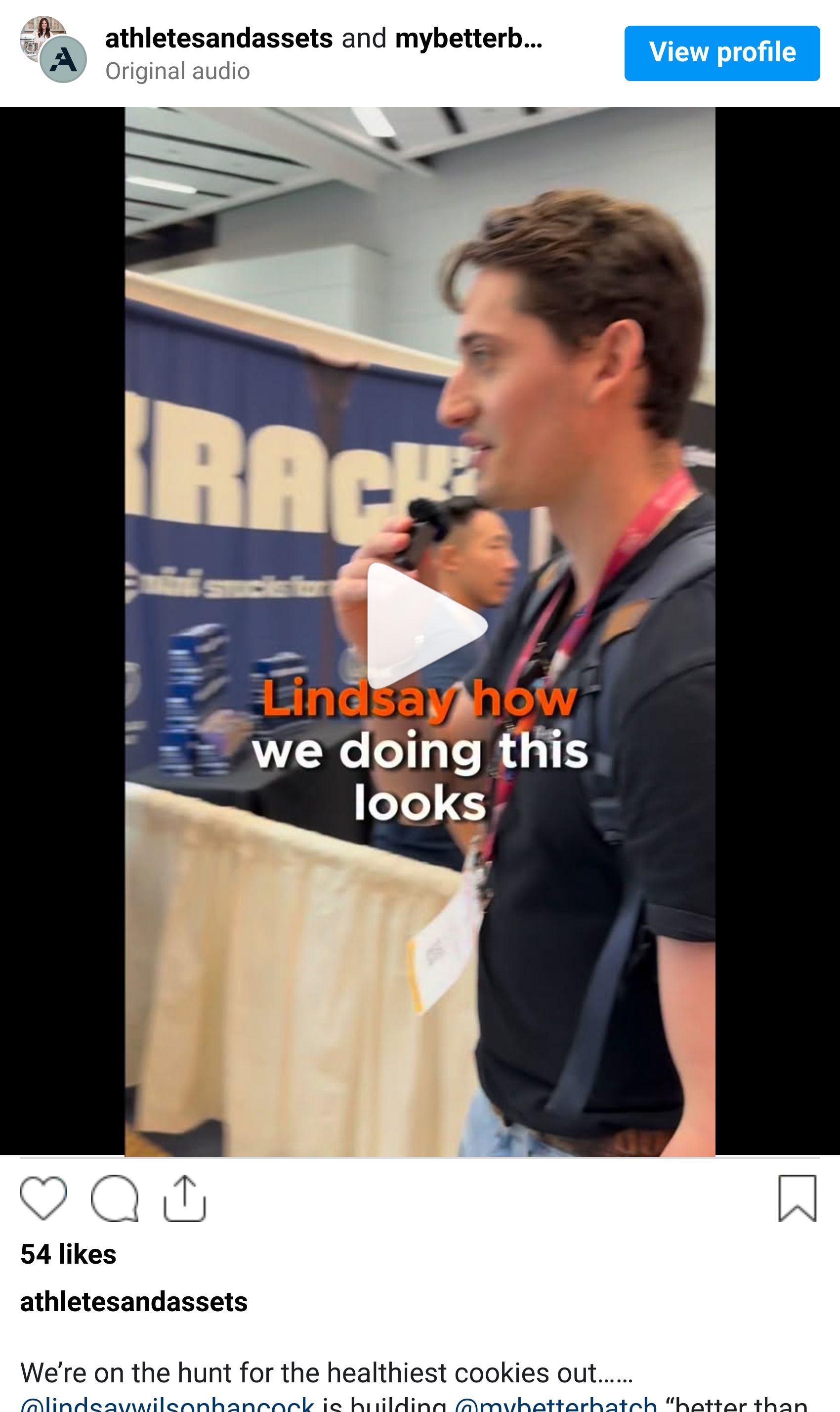
Check out Noah’s interview with founder and CEO of the brand, Lindsay Hancock, here:
Why should athletes care?
Everyday CPG opportunity
Simple ingredient positioning
Family-friendly brand alignment
For athletes looking at consumer brands, a convenient baked good that still feel premium is the type of product that can fit naturally into lifestyle, family, gifting, community events, and social content. Founded by Lindsay, a mom who wanted a better boxed cookie mix that delivered convenience without sacrificing taste; that kind of origin story gives athletes a human brand to align with beyond just product promotion.